What is an ADI? Understanding the "safe intake" figure for additives
The acceptable daily intake (ADI) is a number that appears often in additive news but is often misread. How is it set, what happens if it is exceeded, and why is comparing substances by it misleading?
In news about additives, and in earlier articles on this blog, "ADI" keeps appearing: "ADI of 40 mg/kg," "the ADI is exceeded." The figure is usually misread in one of two directions: either "below it is definitely safe, above it is dangerous," or "there is a limit, so the substance must be harmful." Both are incomplete. This article explains what an ADI is and what it is not.
What an ADI is
An ADI is an estimate of the amount of an additive that can be consumed every day over a lifetime without appreciable health risk. It is usually given in milligrams per kilogram of body weight per day (mg/kg/day). Its purpose is to protect consumers and to harmonise additive rules between countries.
How it is set
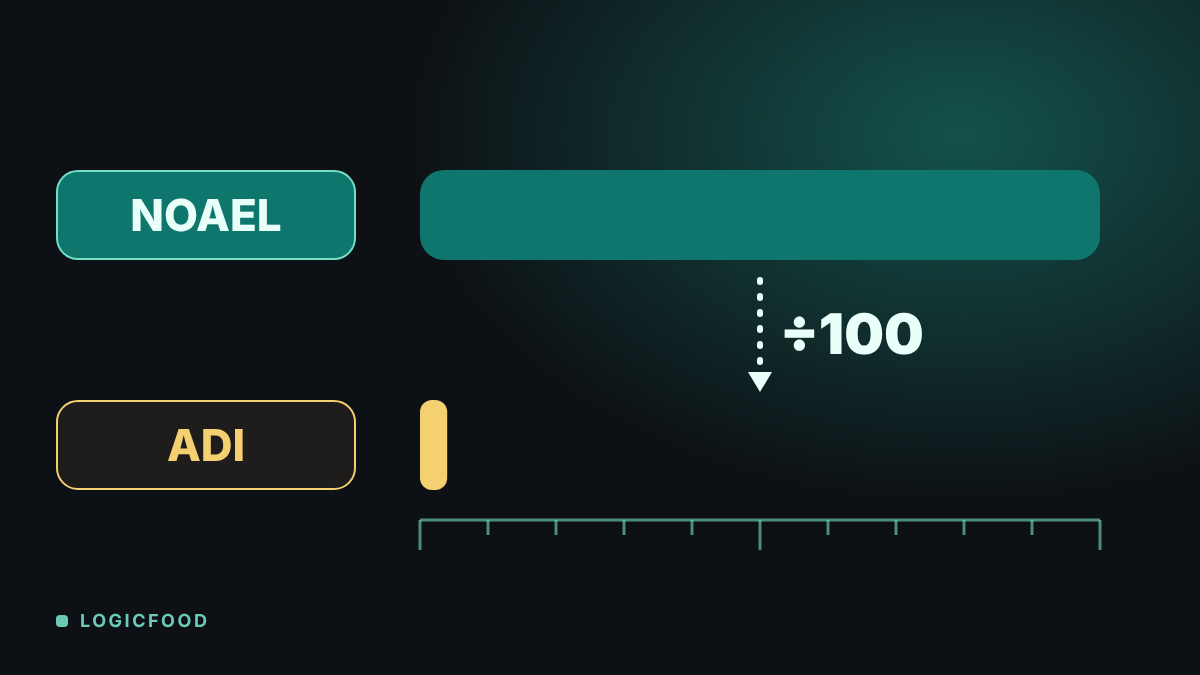
- Scientists find the NOAEL: the highest dose at which the most sensitive test animal showed no adverse effect.
- They divide that dose by a safety factor, usually 100. One factor of 10 covers differences between animals and humans, the other 10 covers differences between average adults and sensitive groups. The factor can be adjusted according to the substance and the data.
- The result is published as the ADI. Internationally this is done by JECFA, the joint FAO/WHO food additives committee; in the EU by EFSA.
So an ADI is a number well below the dose at which no harm was seen in animals.
What happens if the ADI is exceeded?
This is the most misunderstood point. An ADI is a lifetime average, not a daily limit. Exceeding it on a single day is not a concern. If certain population groups are estimated to exceed it regularly, regulators may advise lowering use levels or restricting the foods in which the additive is allowed. Because of the large safety margin, intake would need to exceed the ADI by a considerable amount before a risk arises. ADIs are also set to cover sensitive groups such as children, older people and people who are unwell.
Example ADIs
Values announced by the institutions for some substances covered on this blog:
| Substance | ADI | Body, year |
|---|---|---|
| BHA (E320) | 1.0 mg/kg/day | EFSA, 2011 |
| BHT (E321) | 0.25 mg/kg/day | EFSA, 2012 |
| Sorbic acid / potassium sorbate (E200, E202) | 3 mg/kg/day (temporary) | EFSA, 2015 |
| Benzoates (E210-E213) | 5 mg/kg/day (as benzoic acid) | EFSA, 2016 |
| Nitrite (E249, E250) | 0.07 mg/kg/day | EFSA, 2017 |
| Glutamates (E620-E625) | 30 mg/kg/day | EFSA, 2017 |
| Aspartame (E951) | 40 mg/kg/day | EFSA 2013, JECFA 2023 |
Why comparing substances by these numbers is misleading
The smallest number in the table is not the most dangerous substance, and the largest is not the safest. Each ADI comes from that substance's own toxicological data, the most sensitive effect seen in it and the safety factor used. For one substance the limiting effect may appear in a reproductive study, for another in a different organ. Real intake also differs widely between substances: a low ADI may matter little if a substance is rarely used, and a high ADI can still be approached if a substance is eaten in large amounts.
The meaningful comparison is between a substance's own ADI and its estimated intake. That is why EFSA's opinions say things like "intake is below the ADI" or "may exceed it at high consumption."
The limits of an ADI
- An ADI assesses one substance on its own; it does not cover combination effects.
- Some ADIs are "temporary" and may change as new data arrive, as with sorbates and sulphites. EFSA states this explicitly for some substances.
- For some groups an ADI does not apply, such as people with phenylketonuria for aspartame.
- An ADI is a limit for one substance; it does not evaluate your overall diet.
In short
An ADI is not a "danger line." It is a cautious reference point that regulators set for lifetime average intake. When judging a substance on a label, read its ADI, its estimated intake and the institutions' interpretation together. Now you know what an ADI shows and what it does not.
Sources: EUFIC, questions on acceptable daily intakes (ADIs) · EFSA, BHA (E 320), 2011 · EFSA, BHT (E 321), 2012 · EFSA, sorbates, 2015 · EFSA, benzoates, 2016 · EFSA, nitrites, 2017 · EFSA, glutamates, 2017 · EFSA, aspartame, 2013 · PAHO/WHO, aspartame, 2023