Is aspartame (E951) safe? Reading IARC and EFSA together
In 2023 IARC placed aspartame in the "possibly carcinogenic" group while JECFA left the daily intake limit unchanged. How can both decisions be right at once?
In July 2023 two pieces of news came out on the same day: IARC, part of the World Health Organization, classified aspartame as "possibly carcinogenic to humans," while JECFA, the joint FAO/WHO food additives committee, left the safe daily intake unchanged. Many readers assumed the two contradicted each other. In fact they answer different questions.
What is aspartame?
Aspartame (E951) is an artificial sweetener common in diet drinks, sugar-free gum and tabletop sweeteners. LogicFood's records describe it as roughly 200 times sweeter than sugar, so very little is used. It is fully digested in the body: according to EFSA's assessment it is broken down into phenylalanine, aspartic acid and methanol, and no intact aspartame reaches the bloodstream.
What did IARC say?
IARC classified aspartame in Group 2B, "possibly carcinogenic to humans". It rested on "limited evidence" in humans (specifically for liver cancer), in experimental animals and on possible mechanisms. Group 2B is the third of four levels and is generally used when evidence is limited but not convincing. The classification identifies a hazard; it does not tell you how much risk there is at a given intake.
What did JECFA say?
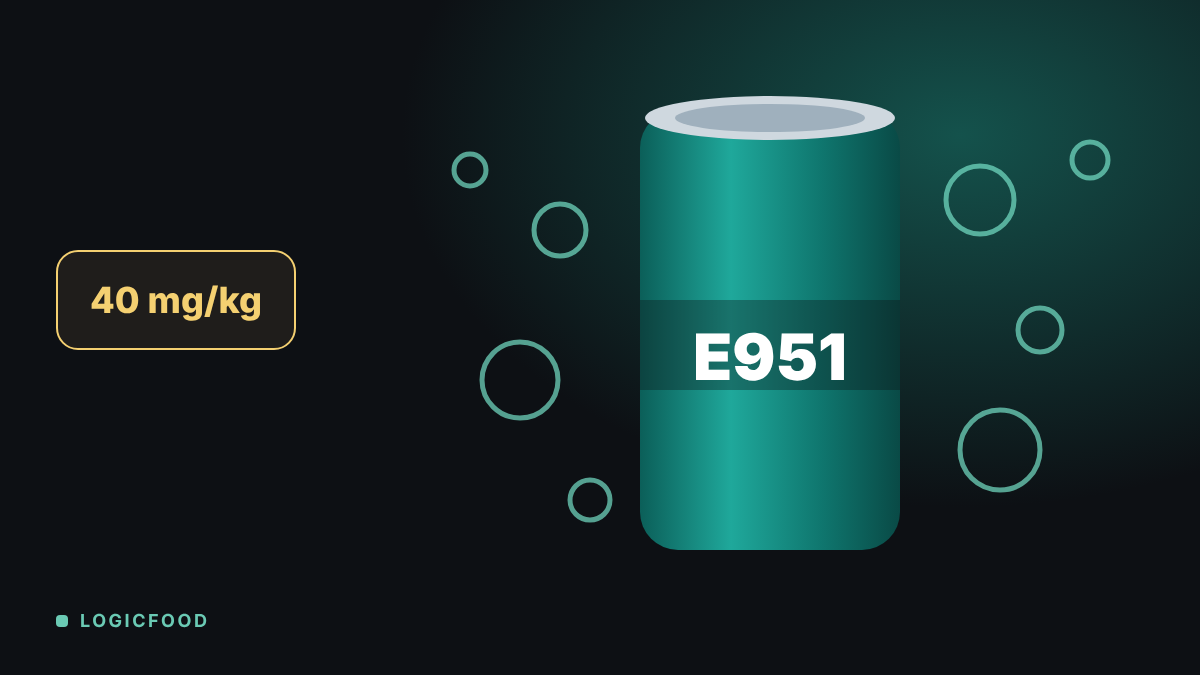
JECFA looked at the same data from a risk angle. It found no sufficient reason to change the existing acceptable daily intake (ADI) of 0-40 mg/kg body weight and reaffirmed it. It also judged the evidence of a link between aspartame and cancer in humans not convincing. The announcement gave an example with cans containing 200-300 mg of aspartame: a 70 kg adult with no other aspartame sources would need to drink more than 9-14 cans of diet drink a day to exceed the ADI.
What does EFSA say?
EFSA re-evaluated aspartame in 2013 and kept the ADI at 40 mg/kg/day. It found that current intake is below the ADI, that the same holds for the breakdown product DKP, and that aspartame is "not of safety concern" at current exposure levels. The ADI does not apply to people with phenylketonuria (PKU), which is why aspartame products in the EU carry the phrase "contains a source of phenylalanine."
Why the two decisions do not contradict each other
IARC asks "can this substance cause cancer?" and grades the strength of the evidence. JECFA and EFSA ask "at what intake does it pose a risk?" The result: the evidence is limited, but normal consumption stays far below the intake limit. One is a cautious flag, the other a quantity limit.
Reading the label
- Look for "sweetener: aspartame" or E951; diet drinks, sugar-free gum and sweets, light yoghurts and tabletop sweeteners are common places.
- "Contains a source of phenylalanine" is for people with PKU; it is not a general warning.
- A product can contain more than one sweetener; an ADI is calculated separately for each substance.
- The ADI is a lifetime average. One high day is not a problem, but sustained high intake is what the ADI is meant to guard against.
In LogicFood's research records
In LogicFood's records aspartame carries the highest risk level (High), and the record is based on IARC's announcement. The marker reflects IARC's hazard classification; read it together with JECFA's and EFSA's conclusion that intakes stay below the ADI.
In short
Calling aspartame simply "carcinogenic" or simply "completely safe" skips half of what the institutions said. IARC says the evidence is limited; JECFA and EFSA say normal consumption stays well under the limit. The decision depends on how much you consume and your own preference.
Sources: PAHO/WHO, aspartame hazard and risk assessment results, 2023 · EFSA, re-evaluation of aspartame (E 951), 2013 · GreenFacts, EFSA aspartame summary