Why was titanium dioxide (E171) banned in the EU?
E171, the additive that makes sweets bright white, can no longer be used in food in the EU after EFSA's 2021 assessment. Here is what the decision rested on and what to look for on labels.
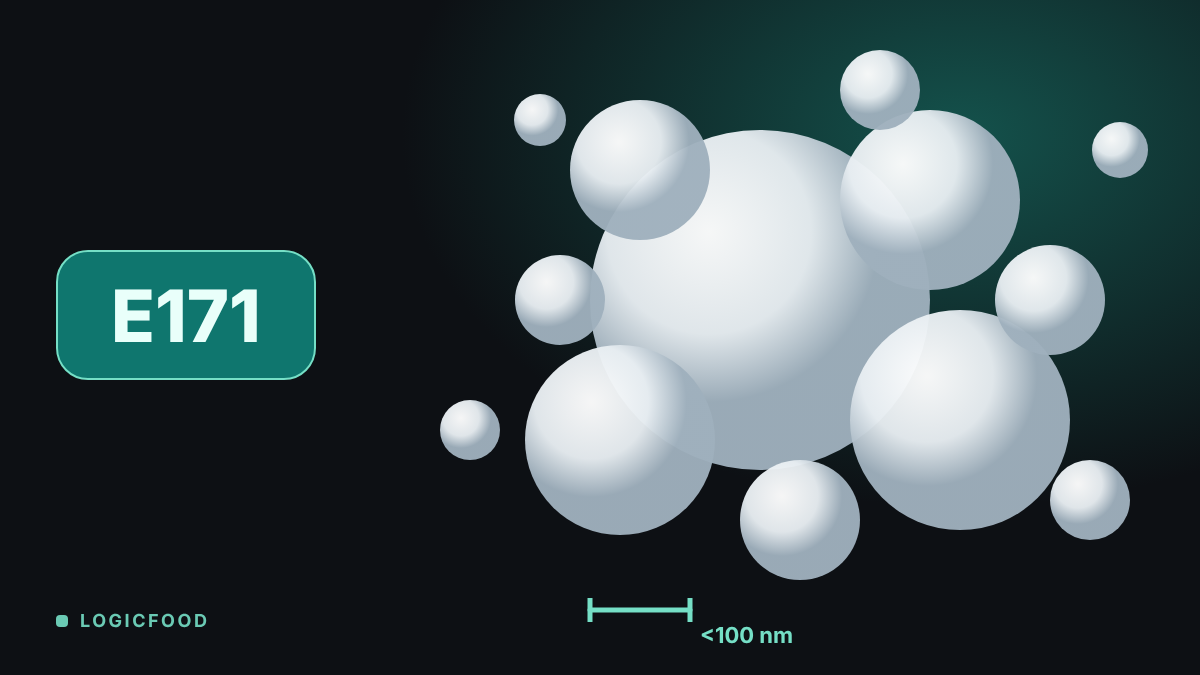
The bright white coating on many sweets, chewing gums and dragées usually comes from a single substance: titanium dioxide, or E171. In the European Union it can no longer be used as a food additive. The decision does not rest on proven harm. It rests on a scientific assessment that could not remove an uncertainty, and that difference often gets lost in headlines.
What is E171 and what was it for?
Titanium dioxide is a white mineral pigment. In food it gave an opaque, bright white colour: confectionery coatings, chewing gum, some sauces and bakery decorations. The same substance is used in paints, cosmetics and medicine coatings. LogicFood's records describe it as a whitening mineral pigment.
What did EFSA say in 2021?
In its assessment of 6 May 2021, the European Food Safety Authority (EFSA) concluded that titanium dioxide can no longer be considered safe as a food additive. In summary:
- It could not rule out that titanium dioxide particles damage DNA (genotoxicity).
- Because that concern could not be resolved, no acceptable daily intake (ADI) could be set; in other words, no safe daily amount could be named.
- E171 was found to contain at most about 50% nano-sized particles (under 100 nanometres) that consumers may be exposed to. EFSA applied its nanotechnology guidance to a food additive for the first time.
- General toxic effects were not conclusive, and EFSA's opinion covered only use as a food additive.
The key point: EFSA did not say "harm has been proven." It said "we cannot exclude the concern and cannot set a safe limit." The decision on what to do rests with the European Commission and member states.
What did the EU decide?
The Commission removed E171 from the list of authorised food additives with Regulation (EU) 2022/63. It was published on 18 January 2022; a six-month transition began on 7 February 2022 and the full ban applied from 7 August 2022. According to a USDA summary, its use as a colour in medicines is subject to a separate review; the ban covers use as a food additive.
How to read this on a label
- Look for "titanium dioxide" or "E171" in the ingredients list.
- For products sold in the EU you would not expect to see it since 2022. For imported products or products made outside the EU, rules differ by country.
- White-coated sweets, chewing gum and glossy decorative products are where you most often met it.
- Seeing E171 on a pack does not necessarily mean the product is illegal; the rules of the country where it was made and sold decide.
In LogicFood's research records
In LogicFood's additive records titanium dioxide carries the highest risk level (High), and the record is based on the EFSA assessment. The marker is a prioritisation signal derived from EFSA's "no safe limit could be set" conclusion, not a verdict of harm on its own.
In short
E171 shows how scientific uncertainty can turn into regulation: harm was not proven, but safety could not be shown either, and the EU took the precautionary route. Recognising the substance on a label also tells you something about which country's rules a product follows.
Sources: EFSA, titanium dioxide (E171) no longer considered safe, 2021 · USDA FAS, EU ban on titanium dioxide as a food additive