Sorbates vs benzoates: two common preservatives explained
Sorbic acid (E200) and sodium benzoate (E211) both hold back mould and yeast. EFSA's intake limits and the benzene question show what to know when reading a label.
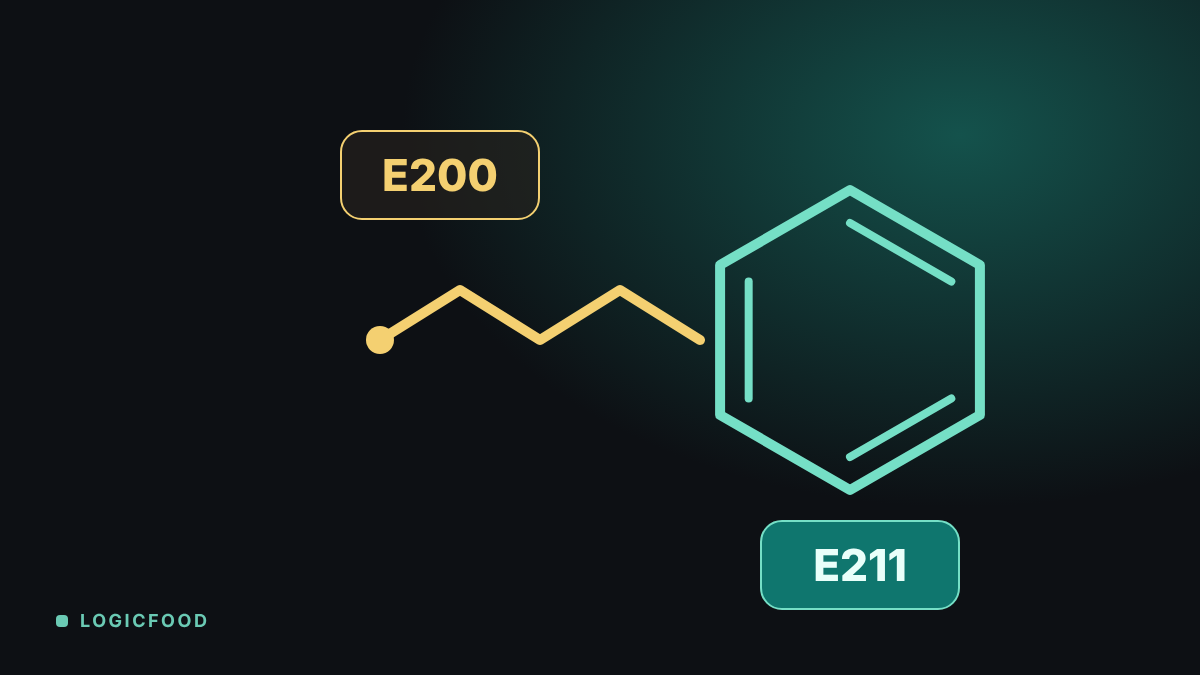
You have probably seen "preservative: E202" or "E211" on a juice carton, a jar of pickles or a ready-made sauce. Those two codes belong to the most widespread families of preservatives in the food industry: sorbates and benzoates. Both slow the growth of mould and yeast and so extend shelf life. They work under different conditions, though, and they come with different questions. This article puts them side by side.
Which code is which?
- Sorbates: E200 sorbic acid, E202 potassium sorbate, E203 calcium sorbate.
- Benzoates: E210 benzoic acid, E211 sodium benzoate, E212 potassium benzoate, E213 calcium benzoate.
Sorbic acid is named after the rowan tree (Sorbus) but is made synthetically today. Benzoic acid also occurs naturally in some fruit; what is added to food is usually a salt form.
What do the safety assessments say?
The European Food Safety Authority (EFSA) has re-evaluated both groups. The key concept is the ADI, the acceptable daily intake: an amount considered to carry no appreciable risk if consumed every day for a lifetime. It is derived by taking the no-effect level from animal studies and dividing it by a safety factor, typically 100.
Sorbates. In its 2015 opinion, EFSA set a temporary group ADI of 3 mg of sorbic acid per kg of body weight per day for sorbic acid and potassium sorbate, replacing an older value of 25 mg/kg after new reproductive and developmental data. The panel found no evidence of genotoxic activity for sorbic acid or potassium sorbate. Calcium sorbate was left out of the group ADI because genotoxicity data were missing. Estimated intake stayed within the limit for most population groups; in a high-intake scenario toddlers and children in one country exceeded it. EFSA returned to the topic in a 2019 follow-up opinion.
Benzoates. EFSA's 2016 opinion set a group ADI of 5 mg/kg body weight per day, expressed as benzoic acid. It also noted that in a brand-loyal consumer scenario the limit could be exceeded, particularly by toddlers and children who regularly drink flavoured drinks. The food categories driving the exceedance were unprocessed fruit and vegetables (natural benzoic acid) and flavoured drinks.
None of these numbers is a bright line between "safe" and "dangerous." An ADI is a reference point for regulators and monitoring. Exceedance scenarios are modelled estimates built on many assumptions and do not describe any particular person.
The benzene question
With benzoates, the topic you hear about most is benzene, a chemical linked to cancer. In drinks that contain both a benzoate salt and vitamin C (ascorbic acid), especially when exposed to light and heat, very small amounts of benzene can form. The reaction was studied in several countries in the mid-2000s.
In Health Canada's 2007 follow-up survey, 139 products were tested and three exceeded the 5 µg/L drinking-water guideline. After manufacturers reformulated, levels fell sharply: in one cocktail mix, removing sodium benzoate cut the average from 11-18 µg/L to 0.041 µg/L. The agency's health risk assessment concluded that low-dose exposure at the levels found does not pose a health risk to the general population, including children.
In short, the issue was treated as a real and fixable formulation problem. It would be wrong to say that every product today has it, and equally wrong to say that none does.
Reading the label
- "Preservative: potassium sorbate" and "E202" are two ways of writing the same thing.
- If sodium benzoate and ascorbic acid (vitamin C) appear in the same drink, that is the combination the benzene discussion is about. It does not mean the product is a problem; it only tells you which combination the debate concerns.
- Sorbates are commonly listed on cheese, dried fruit, baked goods and sauces. Benzoates are typical for acidic drinks, pickles and sauces; an acidic environment is where benzoate works.
- Flavoured drinks that children drink often are one of the categories that stand out in EFSA's benzoate intake estimates.
- If you are worried about allergy or sensitivity, ask your doctor.
In LogicFood's research records
In LogicFood's additive records, sorbic acid (E200) carries a low risk level and sodium benzoate (E211) a medium one. The difference follows the sources in the records: EFSA's finding of no genotoxicity for sorbic acid, versus FDA and National Cancer Institute statements on benzene for sodium benzoate. These levels are not bans or verdicts; they summarise where the sources differ.
Sources: EFSA, sorbic acid and sorbates (2015) · EFSA, sorbic acid follow-up opinion (2019) · EFSA, benzoic acid and benzoates (2016) · Health Canada, follow-up survey of benzene in beverages (2007)